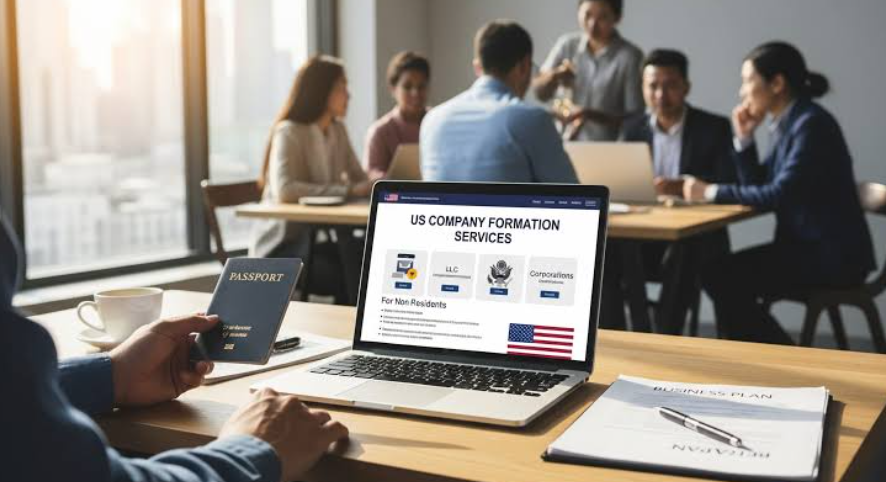
The United States remains one of the most accessible markets for foreign entrepreneurs and business owners looking to establish a formal commercial presence. The legal system is well-documented, the banking infrastructure is mature, and the business environment — while complex in places — follows predictable rules. For a non-resident, however, the process of setting up a U.S. company involves navigating federal, state, and tax requirements that interact in ways that are not always obvious from the outside.
More foreign founders are now registering U.S. entities not just for market access, but for practical reasons: accepting payments in U.S. dollars, working with American clients who require a domestic vendor, or qualifying for U.S.-based software and financial tools that restrict international accounts. Understanding the actual steps involved — and why each one matters — is the starting point for making the process work correctly from the beginning.
Why the Registration Process Looks Different for Non-Residents
When a U.S. citizen starts a business, the path to registration is relatively linear. They already have a Social Security Number, a domestic address, and existing relationships with U.S. financial institutions. For a foreign national doing the same thing, each of those assumed resources becomes a step that requires a workaround or a substitute. The process is not more difficult in principle, but it requires more preparation and a clearer understanding of what each requirement actually means in practice.
For anyone researching how to register a company in usa as a foreigner, the most important early decision is understanding that U.S. business registration is a state-level process, not a federal one. There is no single national body that registers companies. Each state has its own requirements, timelines, filing fees, and ongoing obligations. The federal government becomes relevant primarily for tax registration, not formation.
A detailed breakdown of the structural and tax considerations involved in this process is covered in this guide on how to register a company in usa as a foreigner, which addresses the practical mechanics that go beyond the basic state filing.
Choosing the Right Business Structure Before Filing
Foreign founders typically choose between two structures: a Limited Liability Company (LLC) or a C Corporation. Each carries different implications for taxation, ownership, and investor eligibility. LLCs are popular for small and mid-sized operations because they offer pass-through taxation and fewer administrative requirements. However, LLCs have restrictions on foreign ownership in terms of how income is treated for U.S. tax purposes, which can create unexpected obligations if not planned for correctly.
C Corporations are the preferred structure for businesses that intend to raise investment from U.S. venture capital or institutional sources, as most U.S. investors will not participate in an LLC structure. C Corps are also more straightforward when it comes to issuing equity to multiple parties. The trade-off is double taxation — corporate profits are taxed at the entity level, and distributions are taxed again at the shareholder level.
The structure chosen at this stage has long-term consequences for how income is reported, how taxes are filed, and how the business can grow. Changing structures later is possible but disruptive and often costly. Spending time on this decision before filing is more efficient than correcting it afterward.
Selecting a State for Registration
Because U.S. companies are registered at the state level, foreign founders must choose which state to file in. This choice is not necessarily tied to where the business will operate. Many non-residents register in states with business-friendly legal environments regardless of where their customers are located or where they personally reside.
Delaware is the most commonly cited state for incorporation, particularly for C Corporations, due to its established corporate law, specialized Court of Chancery, and the familiarity that U.S. investors have with Delaware-registered entities. Wyoming is often preferred for LLCs because of its low fees, strong privacy protections, and absence of state income tax. Florida and Texas are also frequently chosen by foreign founders who plan to have a physical presence or operations within those states.
Understanding Registered Agent Requirements
Every U.S. state requires that a registered business maintain a registered agent — a person or entity physically present in the state of registration who can receive legal documents and official correspondence on behalf of the company. For foreign nationals without a U.S. address, this is not optional. It is a mandatory part of the filing process.
Registered agent services are widely available across all states and typically cost a modest annual fee. The agent’s address becomes the official address on file with the state, which satisfies the requirement without the founder needing a physical U.S. location. This is a routine arrangement and does not affect the legitimacy or standing of the company in any way.
Failing to maintain a registered agent can result in the state administratively dissolving the company or creating gaps in the official record that complicate future banking, contract execution, or tax filings. Continuity here is a functional requirement, not a formality.
Obtaining a Federal Employer Identification Number
Once the company is formed at the state level, the next required step is obtaining a Federal Employer Identification Number (EIN) from the Internal Revenue Service. The EIN is the company’s federal tax identification number and is required for opening a U.S. business bank account, hiring employees, filing federal tax returns, and in many cases, executing contracts with larger U.S. clients who require it for payment processing.
U.S. residents can apply for an EIN online through the IRS website and receive one immediately. Foreign nationals without a U.S. Social Security Number or Individual Taxpayer Identification Number must use a paper application process — IRS Form SS-4 — and submit it by mail or fax. The processing time is longer, and applicants must include specific identifying information that can be used by the IRS to verify identity without a domestic tax number.
See also: Business Class Flights to India: Comfort, Luxury, and Best Deals
Completing the EIN Application as a Foreign Owner
The SS-4 form asks for the responsible party of the company — typically the owner or a principal officer. For a foreign founder, this section must be completed carefully. The IRS uses the responsible party designation to associate the entity with an individual for compliance purposes. Errors or inconsistencies in this section are a common cause of delays or rejection.
Some applicants choose to use a U.S.-based third party to submit the application on their behalf, which can simplify the process if the founder is unfamiliar with IRS form conventions. However, the designated responsible party must still be a genuine principal of the company, not simply a service provider. The IRS has tightened enforcement around this distinction in recent years, as outlined in guidance available through the IRS official resources on Employer Identification Numbers.
Opening a U.S. Business Bank Account
For many foreign founders, the bank account step is where the practical difficulty concentrates. U.S. banks are subject to strict anti-money laundering and Know Your Customer regulations, which means they require extensive documentation from new account holders — particularly non-residents who cannot appear in a branch in person.
Traditional banks like Chase, Bank of America, and Wells Fargo generally require in-person account opening, which means the founder must travel to the United States to complete the process. This is feasible but must be planned in advance, including having all documentation in order before the visit.
Fintech-based business banking platforms have expanded the options considerably. Services designed specifically for international entrepreneurs can open accounts remotely with a valid EIN, company formation documents, and identity verification. These accounts function similarly to traditional business checking accounts for most operational purposes, including receiving wire transfers, issuing payments, and connecting to payment processors.
Documentation Requirements and Common Gaps
Regardless of whether the account is opened through a traditional bank or a fintech platform, the documentation requirements follow a similar pattern. Banks typically ask for the company’s formation documents (articles of organization or certificate of incorporation), the EIN confirmation letter from the IRS, a valid government-issued passport, proof of business activity or purpose, and in some cases, a business plan or description of services.
The most common gap at this stage is an incomplete or informal EIN confirmation. The IRS issues a confirmation letter (CP 575) as the official record of the EIN assignment. Some applicants receive only a verbal confirmation or a printout from an online session, which banks do not consistently accept. Retaining the official letter when it arrives is essential for bank account applications and for any future administrative processes that require proof of the EIN.
Understanding Ongoing Compliance Obligations
Registering the company is the beginning of the compliance obligation, not the end of it. U.S. states require annual or biennial reports from registered entities, with associated fees. Failure to file these reports on time can result in late penalties and, in some states, administrative dissolution of the entity. A dissolved entity cannot legally conduct business, enter contracts, or maintain its bank account in good standing.
Federal tax obligations also continue regardless of whether the company generates revenue. A foreign-owned LLC with a single non-resident owner is treated as a disregarded entity for tax purposes but must still file Form 5472 and Form 1120 each year to report transactions between the company and its foreign owner. This requirement applies even in years where there is no taxable income. Missing these filings carries significant penalties under U.S. tax law.
State Tax Registration and Sales Tax Considerations
Depending on the nature of the business, the company may also have obligations under state tax law. Businesses selling physical goods or certain digital products to customers in states where they have economic nexus — a threshold based on sales volume or transaction count — are required to collect and remit sales tax in those states. Economic nexus rules vary by state and have been updated frequently following the Supreme Court’s 2018 decision in South Dakota v. Wayfair, which significantly expanded states’ authority to require out-of-state sellers to comply with local tax obligations.
For service-based businesses, this is often less of a concern, but any company selling taxable goods should conduct a nexus analysis before beginning operations to avoid retroactive liability.
Closing Thoughts
Registering a U.S. company as a foreign national is a structured and achievable process, but it requires attention to sequence and detail. Each step — state formation, registered agent designation, EIN application, bank account setup, and ongoing compliance — connects to the next in ways that make skipping or rushing any single stage consequential for the whole.
The practical challenges involved in learning how to register a company in usa as a foreigner are not primarily legal or regulatory mysteries. They are mostly procedural: knowing which form to use, what documentation each institution requires, and what timelines to expect. Approaching each stage with accurate information and proper documentation resolves most obstacles before they become problems.
For founders who take the time to understand the full picture before filing, the U.S. business registration process is predictable, well-supported by available services, and ultimately manageable. The foundation built in these early steps determines how smoothly the business operates within the U.S. system for years to come.
